There’s a particular kind of quiet that falls over a room of bee farmers when a bee inspector puts up a photo of a frame and asks what’s wrong with it. Nobody wants to be the one who gets it wrong. I spent a day in a room like that recently, at the National Bee Unit’s Healthy Bees Day hosted for members of the Bee Farmers’ Association, and I came away with a notebook full of scribbles and a slightly guilty feeling about my hive tool.
The NBU team didn’t hold back. Jack, a former bee farmer who now manages bee health staff in the Eastern region, said early on that this was not a “hobbyist” session, and he meant it. It was aimed at people running hundreds of colonies, and it was all the better for it.
The DASH scheme
 The morning opened with the Disease Assurance Scheme for Honey bees, or DASH. The idea is earned recognition. If you can show the NBU you know your diseases, keep proper records and run a clean operation, you get more freedom to manage your own stock. You can take your own samples and send them to the lab at York. If it comes back positive you can deal with it yourself, properly reported, without waiting days for an inspector to come out.
That matters more than it used to. The Bee Unit is down by ten or twelve inspectors and has been asked for more savings. One EFB outbreak in a big apiary can tie up a small team for a week.
At the moment there are around 60 DASH members, covering about 11,000 colonies. That’s roughly a tenth of the BFA’s membership. Part of the reason is the 150-colony threshold, and part of it is that there’s now a proper exam. Jack was blunt that it isn’t easy. The training course runs in November, and this day was meant to get people ready for it.
One point stuck with me. Getting disease doesn’t get you thrown off the scheme. If your bees are strong, he said, they’ll find somebody’s neglected colony eventually. The ones who get into trouble are the ones who stop reporting. He described looking at a map with foulbrood all around one DASH member’s boundary and none at all inside it. “Must have some magic beans.”
BeeBase isn’t a back door
Plenty of beekeepers stay off BeeBase because they’re wary of it. Jack went out of his way to say the NBU doesn’t talk to HMRC or Trading Standards. They don’t care who you sell to or what’s in your honey house. All they see is your name, your apiary locations and your inspection records. If your apiaries aren’t on there, you won’t get disease alerts and they can’t look at hives they don’t know exist. If the website drives you mad, ring your local inspector and they’ll update it for you.
Foulbrood: the gooey stuff
 This was the heart of the morning. A few things I wrote down twice.
EFB is the sneaky one. It can sit in a colony with no symptoms, getting carried around on frames, gloves and hive tools, until something stresses the bees. That might be a varroa spike, a dearth, or the end of the season. Then you start to see twisted, melted, discoloured larvae. The giveaway is the white “mayonnaise” gut you can pull out with tweezers. If you see that, Jack reckons it’s EFB 99 times out of 100, and it’s exactly what the lab wants in a sample.
It’s also tough. EFB will survive on comb for three years, and for 18 months in honey. Think about that next time a wet super sits in the shed over winter. Strain typing lets the NBU trace outbreaks, and he talked about strain 39, which first turned up in 2015 and was spread across the country largely by one beekeeper. An area that’s “EFB-free” today is usually just one the inspector hasn’t reached yet.
AFB is rarer, at only a few percent of notifiable disease diagnoses, but nastier. Look for sunken, greasy, perforated cappings, a pepperpot brood pattern and the rope test. The spores are known to last at least 40 years. His advice on the matchstick you’ve just roped with? Put it back in the hive. That hive is going in the fire anyway, and you don’t want the stick anywhere else.
Follow the kit
The most useful part for me was about how disease moves round an operation. It’s mostly us. Gloves, hive tools, smoker bellows, the truck’s gear stick, frames out of a big spinner going back into whichever box is nearest, supers stacked on a filthy floor. One study swabbed the inside of a beekeeper’s truck and found EFB everywhere.
He asked us to imagine two apiaries diagnosed tomorrow and a third six weeks later. Could you say where every bit of kit from those sites had been over the last two years? Most of us went a bit quiet.
The fixes aren’t complicated. Work your low-risk apiaries before your high-risk ones. Mark supers by apiary, even just with a coloured clip, so if one site goes down you’re not burning 800 boxes. Keep a “dirty” area in the store for kit that hasn’t been sorted yet.
There’s a new washing recipe too. The NBU now adds bleach to the old soda solution. Dissolve a kilo of soda crystals in four and a half litres of water. When you need it, take a litre and add 30ml of thin bleach (they use Domestos), giving the tools 20 minutes in it. It’s only good for 24 hours, so make it fresh each day. Bee suits just need a normal wash at 40.
Varroa still runs the show
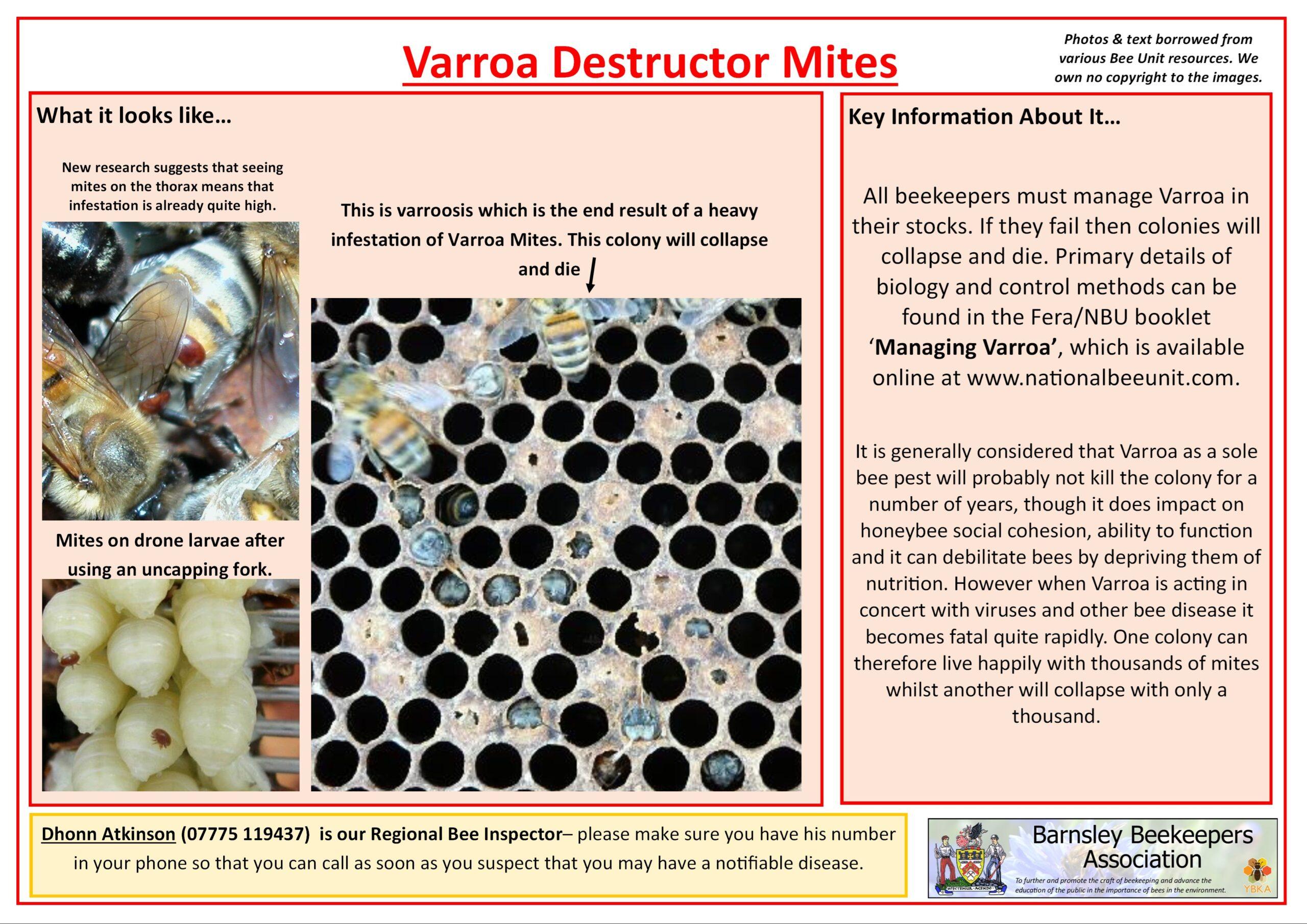 After the break Jack moved on to varroa, and he was clear that it’s still the main reason colonies die. It’s also usually what tips a quiet EFB infection into a visible one.
The figure that stopped the room was from NBU research: in July, around 40% of the varroa in your colony isn’t from your colony. It drifts in from everyone else’s bees. So you can treat well and still be reinfested within weeks if your neighbours haven’t. In busy areas he uses an oxalic dribble for an instant knockdown, then Apivar strips to catch anything coming back in.
There are currently 14 licensed varroa treatments in the UK, and the full list is on the VMD’s product database. Some practical reminders:
- Formic Pro has replaced MAQS, but unlike MAQS it can’t be used with supers on.
- Oxalic dribbles won’t get through cappings, so treat when there’s little or no brood, or repeat 14 days later.
- If you vaporise oxalic, wear a proper respirator with organic acid cartridges.
- Rotate your treatments. Resistance builds when you keep using the same one, and it doesn’t really go away once it’s there.
- Anything you put in a hive to treat varroa has to be recorded, and you keep those records for five years.
He also suggested picking one test colony per apiary and counting mites before and after treatment. If the numbers barely move, your treatment isn’t working.
Tropilaelaps: the one to worry about
In the afternoon Caroline, the Regional Bee Inspector for the Western region, talked about Tropilaelaps, and this was the sobering bit of the day. It isn’t in the UK yet. It’s been notifiable since 2006, though, and it’s moving west through Russia, Ukraine and Georgia. And now Turkiye.
It breeds about twice as fast as varroa. It feeds on open larvae as well as sealed brood, and it’s tiny, pale and very quick. She had a real one in a tube and you could barely see it. A brood break, which helps against varroa, may not get rid of it. In one study in Georgia, an apiary went from no mites to two mites in two colonies, and then to all 86 colonies infested within a few months.
Thousands of queens come into the UK every year through Ireland. With the best will in the world, a mite that size isn’t going to be spotted in a queen cage at a border post. There’s also no treatment licensed for Tropilaelaps. If it arrives, we’ll be relying on varroa treatments and hoping they work. Paul, one of the bee farmers, made a fair point that UK licensing may not allow treatment often enough to keep it under control.
What I’m changing
I’ve got a smaller operation than most people in that room, but I came home and looked at my smoker bellows properly for the first time in years. It wasn’t pretty. Supers are getting marked by apiary this winter, and the soda bucket is getting its bleach.
The message of the day was simple enough. Disease doesn’t mean you’re a bad beekeeper. Hiding it, ignoring it or carting it round on your gloves is a different matter. The NBU would much rather get a blurry photo from you on WhatsApp than find a pit full of burnt colonies six months later.
My thanks to the BFA for hosting, and to Jack, Caroline, Paul, Liz, Ben and the rest of the NBU team for a long and very useful day.